2 comments, add yours

First Look at the Burns Collection of Early Medical Photographs

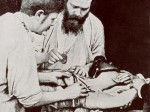
NYC breast surgeons in 1886 Burns_Archive_023_540x405

CBS News has posted a gripping set of images, mostly of cancer patients, dating to the 1880s. The photos from the Burns Archive are graphic, as much as they’re telling, instructive and rare.

This pho­to­graph, taken in New York City in 1886, is one of the ear­liest ever taken of breast surgery. Sur­geons had begun to adopt infection-​​​​control mea­sures in the oper­ating room, but at this point they hadn’t yet adopted the use of sur­gical masks and hats and their sur­gical gowns were simply put on over their street clothes. The anes­the­si­ol­ogist whose hands are visible holding the patient’s arm on the left side of the frame is wearing street clothes. Anes­the­si­ol­o­gists were the last doctors to don sur­gical clothing in the oper­ating room.

Credit: Dr. Stanley B. Burns, via CBS News

According to its website, the Burns Archive houses the nation’s largest and most comprehensive

See more First Look at the Burns Col­lection of Early Medical Photographs

1 comment, add yours

A Play About the Life and Work of Dr. Rosalind Franklin

photo51web2

Franklin’s story starts like this: She was born in 1920 to a Jewish family in London. She excelled in math and science. She studied physical chem­istry at Cam­bridge, where she received her under­graduate degree in 1941. After per­forming research in pho­to­chem­istry in the fol­lowing year on schol­arship, she joined the British Coal Util­i­sation Research Asso­ci­ation (BCURA) and carried out basic inves­ti­ga­tions on the micro-​​structure of coal and carbon com­pounds, and so earned a Ph.D. from Cam­bridge Uni­versity. She was a polyglot, and next found herself in Paris at the Lab­o­ra­toire Central des Ser­vices Chimique de l’Etat, where she picked up some fine skills in x-​​ray crystallography.

You get the picture: she was smart, well-​​educated and totally immersed in physical chem­istry before, during and after WWII. Single-​​minded and focused, you might say –

See more A Play About the Life and Work of Dr. Ros­alind Franklin

1 comment, add yours

Notes on Cholera, Old and New

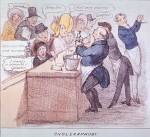
illustration by Robert Seymour (1831), image from the National Library of Medicine, image A021786

Dr. John Snow, an anes­the­si­ol­ogist and founder of public health, rec­og­nized the mode of cholera’s spread more than 150 years ago in London, where he became famous for man­dating the closure of the Broad Street Pump. Snow died at the age of 45, of what was said to be apoplexy, old jargon for a stroke. In 2009, there were 221,226 cholera cases reported and 4,946 cholera deaths in 45 coun­tries, according to the CDC. Based on infor­mation put together by the World Health Organization,

See more Notes on Cholera, Old and New

1 comment, add yours

SNL Classic, on Bloodletting and Barbarism

A student clued me in on an old take on ther­a­peutic phle­botomy: the classic 1978 SNL skit, Theodoric of York (Season 3, episode 18), stars Steve Martin (as the barber, Theodoric of York.). It also fea­tures Dan Aykroyd (as William), Gilda Radner (as Broom Gilda), Jane Curtin (as Joan), John Belushi (as a hunchback) and a youthful Bill Murray (as a drunkard).

Theodoric of York

It’s a very funny skit when it’s not too gory, with some insight into the history of medicine.

But it’s also a sad reminder about the early deaths of Belushi, a promising actor who died at 33 years from heroin and cocaine tox­icity, and of Radner, a won­derful comedian who died at 42 years from ovarian cancer.

As for modern, ther­a­peutic phlebotomy -

In the U.S. and most other places, trained physi­cians, nurses and other providers perform this pro­cedure rou­tinely using sterile tech­niques and

See more Classic Sat­urday Night Live on Blood­letting, and Barbarism