|
|
By Elaine Schattner, MD, on January 22nd, 2012
Paula Deen’s new message
I never heard of Paula Deen until this week, when the plump Food Channel celebrity and cookbook author announced she has Type 2 diabetes. The Georgia-born, sweet tea-loving cook has teamed up with Novo Nordisc to spread the word about dietary modification and life with diabetes. Her new platform, Diabetes in a New Light, highlights a drug she’s taking called Victoza.
Type 2 diabetes tends to develop in overweight people who become resistant to insulin. Thi disease is epidemic in North America; it affects over 8 percent of the population. Almost 95 percent of adult-onset diabetes cases are Type 2; many could be avoided by diet and lifestyle modification. Diabetes causes blood vessel abnormalities throughout the body; it leads to secondary illnesses like heart disease, stroke, poor vision and blindness, kidney problems, neuropathy and other serious health problems. It’s a costly disease, apart from the
See more A Good Outcome from Celebrity Chef Paula Deen’s Message about Diabetes?
By Elaine Schattner, MD, on January 2nd, 2012 The December issue of Wired Magazine profiles David Kirchhoff, CEO of Weight Watchers, in a story on new ways to measure calories and food. It’s an interesting piece, with several points worth contemplating at the start of the year.
Kirchhoff, who gained some 70 pounds in his years after high school, writes a blog about the ups and downs of his physical self. When he first came to Weight Watchers, it was a regular points-minded participant. Now, as a fit CEO, he’s changed the plan. In December 2010, the company adjusted its algorithm for counting points. Among the revisions, a banana and other fibrous fruits are relatively encouraged relative to other, less nutritious foods with similar amounts of calories.
The two main points I took away from the Wired story by Jeffrey O’Brien, supplemented by reading of his and sources are these:
1. The effectiveness of Weight Watchers derives largely
See more A Healthy New Year’s Resolution with a Social Twist
By Elaine Schattner, MD, on November 9th, 2011
Last week Forbes ran a photo-feature on the 7 most powerful ‘foodies’ in the world, according to author Michael Pollen.
Michael Pollen, Forbes, Nov 2011
So who made it onto the short list?* with annotation by ML:
1. Michelle Obama (First Lady, mother, organic farmer-in-chief and Let’s Move! fitness enthusiast)
2. Marion Nestle, Professor, New York University (a neighbor, I’d like to meet!)
3. Josh Viertel, President, Slow Food USA (need to learn more)
4. Will Allen, Urban Farmer (ditto)
5. Jack Sinclair, Head of Grocery, Wal-Mart (who knew they’re the largest vendor of bananas in the US? I did! by listening to the Brian Lehrer show, some time ago.)
6. Ken Cook, Executive Director, Environmental Working Group (sounds reasonable)
7. Mark Bittman, Columnist, The New York Times (he’s on Twitter).
It seems to this homemaker/mom/physician that this group may indeed influence how, where and what we eat. The
See more Seven Powerful ‘Foodies’ on Forbes, Influence on Public Health?
By Elaine Schattner, MD, on November 2nd, 2011
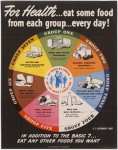
A curious diagram appeared in the most recent NEJM, in a perspective on U.S. dietary guidelines. It’s a USDA food wheel from the early 1940s. With Twitter-like style, it says: “For Health…eat some food from each group…every day!
The details are rich: “butter and fortified margarine” constitute 1of the 7 groups. Further inspection-worthy, IMO.
—
Related Posts:Maybe We Should Teach Medical Students About Healthy LivingMyFoodAPedia, A Government-Sponsored Resource For Nutritional FactsContemplating Diet and Nutrition: A First Look at the USDA’s New GuidelinesA Good Outcome from Celebrity Chef Paula Deen’s Message about Diabetes?A Healthy New Year’s Resolution with a Social Twist
By Elaine Schattner, MD, on September 22nd, 2011 In the city where I live, it’s hard to buy a muffin at a Starbucks without stepping back from the counter and reconsidering. Swallowing 460 calories for a minimal-nutrient breakfast seems foolish.
So I eat fewer muffins than I used to. The posted nutritional tidbits, however imprecise, on the contents of pieces of quiche, slices of pizza and cups of thick soup, stick with me when I travel, and at home.
That’s me, just n=1.
Yesterday the mayor gave a speech at the U.N. He’s quoted in today’s WSJ health blog:
In a speech to the U.N. General Assembly earlier this week, Mayor Michael Bloomberg rattled off New York’s achievements: a tough anti-tobacco campaign that made cigarettes, at about $11.20 a pack, the most expensive in the nation and led to a reduction in adult smoking rates to 14% in 2010 from 22% in 2002 (the national rate is 19.3%).
See more New York City Mayor Bloomberg Promotes Healthy Lifestyle Choices
By Elaine Schattner, MD, on September 14th, 2011 Last week I wrote a simple post on eating yogurt with fresh fruit for lunch. It wasn’t until later that I realized why it’s a medical lesson.
It happens that yesterday morning I was up and out early. I saw a former colleague walking along the street. He’d gained weight, and walked slowly. I thought about how hard he works, and what a good doctor I know him to be. And yet any citizen or patient might size him up as heavy, maybe even unhealthy.
The problem is not that he’s uneducated or can’t afford nutritious foods. He knows fully about the health benefits of losing weight and exercise. The problem is the stress and long hours of a busy, conscientious physician’s lifestyle.
When I worked as a practicing doctor and researcher at the hospital, I rarely ate a nutritious breakfast or lunch. My morning meal, too often, consisted of
See more Maybe We Should Teach Medical Students About Healthy Living
By Elaine Schattner, MD, on September 9th, 2011
For today I thought I’d skip writing a formal post and try a picture, instead, of yesterday’s lunch – fruit with yogurt, honey and crumbled cereal:
Ingredients:
Plain, low-fat yogurt (I use Fage brand, 2% fat, 1⁄4 — 1⁄3 cup)
Honey, less than 1⁄2 teaspoon
Cereal (a fistful of your preference – I like “Smart Start,” roughly 1⁄4 — 1⁄3 cup)
Fruit – whatever’s ripe and in the ‘fridge: in this case I included cut honeydew melon and a nectarine, grapes cut in halves and some blueberries
Easy to prepare:
1. Transfer yogurt to a cereal or soup bowl. I usually use a tablespoon to take 3–4 dollops.
2. Add the honey and use a teaspoon to swirl it through the yogurt.
3. Crumble the cereal in your fist, above the bowl — so that the small pieces fall into the yogurt. Mix everything with the spoons.
(You may
See more Lunch with Yogurt, Honey, Crumbled Cereal and Cut Fruit
By Elaine Schattner, MD, on August 19th, 2011
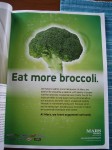
MARS chocolate ad
The other day, over lunch, I was reading the Sept 2011 issue of the Atlantic and came upon this image on p. 37. According to the not-so-fine print, this full-page broccoli fix is sponsored by MARS chocolate, North America, website listed:
www.marshealthyliving.com
So we can find out about nutrition from the company that manufactures M&M’s, Snickers, Twix, MilkyWay and 3Musketeers.
Part of a trend –
The New Yorker recently ran a profile of PepsiCo CEO Indra Nooyi that almost persuaded me the super-sized soda-based conglomerate does the right thing in the healthy living department.
Kinda like Shell, Exxon and BP doing good work for the environment.
Got it?
–
Related Posts:A Vitamin Chart From the National Women’s Health Information CenterThe Broccoli ConnectionContemplating Breast Cancer, Beyond October 2012A Good Outcome from Celebrity Chef Paula Deen’s Message about Diabetes?A Healthy New Year’s Resolution with a Social Twist
By Elaine Schattner, MD, on July 21st, 2011
On the local, national and nutritional fronts:
How refreshing, in this heat, that Fairway opened a new store on East 86th Street yesterday. Coincidently, Michelle Obama’s push to eliminate “food deserts” – places where it’s hard to find affordable fresh produce and other healthy foods – was highlighted this week when several big retailers signed on to the initiative.
PHOTO CREDIT: DNAinfo/Amy Zimmer (Manhattan Local News)
There was a carnival-like atmosphere on the sidewalk outside the new store, which occupies a large, multilevel space where there used to be a Circuit City (bankrupt, closed) and a Barnes & Noble (moved). Inside, I made a rough tally of unpackaged (6 varieties), nectarines (4), plums (3), string beans (4, including a yellow variant I’ve never seen before), potatoes (11 non-sweet, + yams and “yellow yams”), onions (7), mushrooms (5), not counting the pre-packaged kinds), peppers (11), tomatoes (9) and beets (3).
See more New Fairway Delivers Fresh Produce to My Neighborhood
By Elaine Schattner, MD, on May 20th, 2011
A note on cooking with leeks, inspired by a NYT Well post with a list of related Recipes for Health:
I use leeks all the time, as my neighbors are probably too aware. I use leeks sautéed in olive oil as filler, mixed with an egg and flour for a tart, or to season simple pasta, or to flavor and decorate roasted potatoes.
How I prepare leeks is this:
First I cut off the base and ragged tips of 3–4 stems, slice the mainly dark-green stems lengthwise, and then cut the stalks into 1 — 3 inch sections, depending on what they’ll be used for. Because there’s often dirt from the ground deep in the lower, paler sections of the leeks, I manually expose and separate each rounded layer, and then wash everything under briskly-running water, thoroughly rinsing at least three times.
You don’t have to dry the cut, washed
See more Cooking With Leeks
By Elaine Schattner, MD, on March 21st, 2011
I first heard about quinoa a few years ago, when food-sellers started marketing the stuff as a cereal-like, cholesterol-lowering nutritious substance.
Chenopodium Quinoa (Wiki Commons)
It’s from the Andes, I knew, and comes in some varieties. If you purchase the raw stuff or receive a gift, say, from a Peruvian person who knows her quinoa, you’ll find quickly that you have to rinse it a few times with water before cooking it with whatever seasoning you choose, such as cilantro or just a pinch of salt, or with some olive oil and ground pepper, cinnamon or curry, because the starch has to be rinsed of its saponin (soapy) coating.
What I learned yesterday, beginning with an informative feature in the Times, is that quinoa is not a grain but a seed. According to that article and Wikispecies (a fabulous web-find, in itself), quinoa belongs to the chenopod family or
See more A Nutritional Tidbit, on Quinoa
By Elaine Schattner, MD, on February 23rd, 2011
Lately I’ve been worrying about Kevin’s refusal to eat broccoli, and wondering what exactly is so good about those green bunches of roughage. In browsing the Web for more detailed information on the matter, I found a helpful vitamin chart.
This table comes from the HHS-sponsored National Women’s Health Information Center — a good spot to know of if you’re a woman looking on-line for reliable sources. It’s a bit simple for my taste. In the intro, we’re told there are 13 essential vitamins our bodies need. After some basics on Vitamin A — good for the eyes and skin, as you probably knew already — the chart picks up with a quick review of the essential B vitamins 1,2,3,5,6, 9 and 12 (my favorite), followed by a rundown on Vitamins C, D, E, H (that would be biotin) and K:
See more A Vitamin Chart From the National Women’s Health Information Center
By Elaine Schattner, MD, on February 9th, 2011
The other day I came upon MyFoodAPedia.gov, sponsored by the U.S. Department of Agriculture. I love the site’s name and logo.
The site allows you to look up a food and see how cooking it in different ways, or adding sauce or a condiment, affects the calories and nutritional components. Try looking up what’s in a half cup of broccoli florets, raw, cooked, or cooked with some butter. Or an English muffin…
See more MyFoodAPedia, A Government-Sponsored Resource For Nutritional Facts
By Elaine Schattner, MD, on February 6th, 2011
On Sunday afternoons I tend to think about food for my family. Sometimes that’s because we’re having a few more than usual at the dinner table. Also, it’s a time when I order the bulk of fish, meat, produce and other ingredients for the week ahead.
Since I had cancer, I’ve paid much more attention to the food I serve in our home than before. While a balanced diet is no fail-safe for avoiding disease, I do think it’s prudent to be aware of the variety and quantity of food we eat. In medical school we learned surprisingly little about nutrition. Most of what I know I’ve learned from reading books – like Michael Pollen’s In Defense of Food – and reading through detailed reports like the USDA’s new Dietary Guidelines for Americans (7th Edition) issued a few days ago.
From the press USDA and HHS joint press release:
Because
See more Contemplating Diet and Nutrition: A First Look at the USDA’s New Guidelines
By Elaine Schattner, MD, on January 21st, 2011
…for this Friday morning, I’ll just mention the perspective piece called Can Congress Make You Buy Broccoli? And Why That’s a Hard Question. Really I think the better question is whether or not the government can force people to eat broccoli.
And how could the NEJM authors have known about last night’s episode of the Office, that Michael would break HR rules by forcing Kevin to eat a stalk of raw broccoli…Kevin spat it out, forcefully and problematically for some viewers.
My tentative conclusion is that …
See more The Broccoli Connection
|
|
connections…