The U-Shaped Curve of Happiness
This evening, when I finished cleaning up the kitchen after our family dinner, I glanced at the current issue of the Economist. The cover features this headline: the Joy of Growing Old (or why life begins at 46). It’s a light read, as this so-influential magazine goes, but nice to contemplate if you’re, say, 50 years old and wondering about the future.
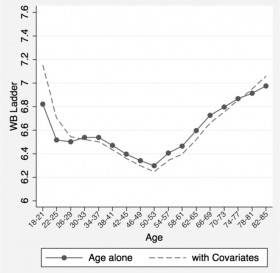
The article’s thesis is this: Although as people move towards old age they lose things they treasure—vitality, mental sharpness and looks – they also gain what people spend their lives pursuing: happiness.
Fig. 1 (left): “A snapshot of the age distribution of psychological well-being in the United States,” Stone, et al: PNAS, May 2010 (y-axis: WB stands for well-being)
Young adults are generally cheerful, according to the Economist‘s mysterious author or authors. Things go downhill until midlife, and then they pick up again. There’s a long discussion in the article on possible reasons for the U-shaped curve of self-reported well-being. Most plausible among the explanations offered, which might be kind-of sad except that in reality (as opposed to ideals) I think it’s generally a good thing, is the “death of ambition, birth of acceptance.” The concept is explained: “Maybe people come to accept their strengths and weaknesses, give up hoping to become chief executive or have a picture shown in the royal Academy…” And this yields contentedness.
.jpg "Pete Townshend, The Who")
Somewhere in the midst of the piece the authors quote Pete Townshend of the Who, who when he was 20 wrote the lyric, “Hope I die before I get old.” The leading guitar-smasher has a blog (which seems to have migrated from Blogger to a Who fan club site that requires registration). The Economist reports he’s expressing himself with apparent delight, now in his mid-60s. The rage is over; he’s mellowed.
Of course I know as a doctor, and as a person who knows other people, that not everyone follows the same emotional trajectory in life. Still, it’s a nice concept and a cute graph. Another, serious limitation is that not everyone gets to grow old.
There’s some happy, econ-light thrown in to the story:
…This curious finding has emerged from a new branch of economics that seeks a more satisfactory measure than money of human well-being. Conventional economics uses money as a proxy for utility—the dismal way in which the discipline talks about happiness. But some economists, unconvinced that there is a direct relationship between money and well-being, have decided to go to the nub of the matter and measure happiness itself.
These ideas have penetrated the policy arena, starting in Bhutan, where the concept of Gross National Happiness shapes the planning process. All new policies have to have a GNH assessment, similar to the environmental-impact assessment common in other countries.
Measuring GNH? That’s a fabulous new parameter we might follow, not just for the holidays.
Cheers!
Age gracefully!
Freelance MD
Quite agree about growing happier. Now heading fast towards 60, I certainly am. So were most of the folk I interviewed for my book on sex, meaning and the menopause.
This could also be somewhat contributed to having children. Happiness goes down around the age people start having kids and goes up again as they leave the nest. I think it’s more than coincidence.