A Play About the Life and Work of Dr. Rosalind Franklin
Last weekend I snagged a last-minute ticket to see Photograph 51, a new play about the work and life of Rosalind Franklin. Her data, possibly stolen, enabled Francis Crick and James Watson to decipher and model the double-helix structure of DNA.
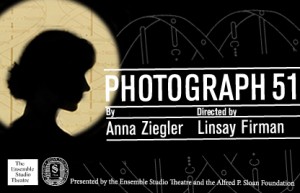 The intimate production, enacted by the small Ensemble Studio Theatre on the second floor of a nondescript building on West 52nd Street, affords a fresh look, albeit partly fictionalized, into important moments in the history of science. Most of the scenes take place in a research lab in post-War London, at King’s College, where Franklin took on a faculty appointment.
Franklin’s story starts like this: She was born in 1920 to a Jewish family in London. She excelled in math and science. She studied physical chemistry at Cambridge, where she received her undergraduate degree in 1941. After performing research in photochemistry in the following year on scholarship, she joined the British Coal Utilisation Research Association (BCURA) and carried out basic investigations on the micro-structure of coal and carbon compounds, and so earned a Ph.D. from Cambridge University. She was a polyglot, and next found herself in Paris at the Laboratoire Central des Services Chimique de l’Etat, where she picked up some fine skills in x-ray crystallography.
You get the picture: she was smart, well-educated and totally immersed in physical chemistry before, during and after WWII. Single-minded and focused, you might say –
Franklin in Photograph 51 wears a simple brown dress with large black buttons straight down the middle of her lithe frame. Her lipstick and haircut seem right, but her three inch heels, even after a few years of experiencing the joie de vivre in Paris, or just being holed up in a research institute there, seem a tad too high for such a pragmatic soul. The lab set is perfect with its double-distilling glassware, wooden pegs on racks, tall metal stools with small, flat circular seats, light microscopes, heavy metal desks with file drawers and a contentious cast of characters.
As this narrative goes, Franklin spurns socializing with most of her colleagues. They find her difficult. She spends nearly all of her time and late hours using x-rays to generate crystallographic images of DNA and making detailed notes and related calculations. Eventually a lab assistant gives her key data, Photograph 51, to her colleague, Maurice Wilkins, who is inexpert in crystallography and cannot independently interpret the structure. While Franklin continues working at a measured pace, refusing to rush into publishing a model until she’s sure of her findings and the implications, Wilkins shares the image with Watson and Crick. They move quickly, publish first in Nature and, later, win the Nobel Prize for the discovery. Meanwhile Franklin leaves Wilkins’ lab and starts a new project on the structure of tobacco mosaic virus. She dies at the age of 37 of ovarian cancer, likely caused or effectuated by the radiation to which she exposed herself at work.
It’s a sad story, but instructive, engaging and very well-done, so much that it’s haunted me for days. Hard to know what’s real –
According to a program note from Anna Ziegler, the playwright: “this play is a work of fiction, though it is based on the story of the race to the double helix in England in the years between 1951 and 1953.” Ziegler refers to several books from which she drew material: The Dark Lady of DNA (by Brenda Maddox), The Double Helix (by James Watson) and The Third Man of the Double Helix (by Maurice Wilkins).
My favorite part is Franklin’s statement at the beginning: “We made the visible, visible.”
—
For a (depressing) counterpoint to this play’s version of events, you can take a look at Nobel Laureate James Watson’s 2007 TED lecture on YouTube. “She was a crystallographer,” he says of Franklin, and other things, before delving into his late-life happiness and current ventures in cancer genetics and autism studies.
Dear Dr. Elaine,
Such moving story! Particularly because we know of so many cases where the real author’s name ends up hidden or appears tugging after a better known name.One would never expect such petty behavior among scientists but, I guess, fame and vanity are forces stronger than ethics. As per Watson, I heard from people who knew him well, that in his time in Woods Hole his harassment of young female scientists was notorious.