What Not to Wear In the Hospital While Recovering From a Stroke
Today’s Annals of Internal Medicine includes new results for the CLOTS (Clots in Legs Or sTockings after Stroke) Trial. Not-quite acronyms aside, it’s an interesting study with implications for many patients at risk for deep venous thrombosis (DVT).
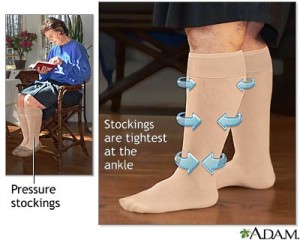
This U.K.-based study, involving 3114 patients in 112 hospitals in 9 countries, used ultrasound to evaluate possible DVTs in legs of people after they’d been immobilized upon suffering strokes. Patients were randomized to receive either thigh-length or below-the-knee compression stockings while recovering in the hospital. The main result was that 98 of 1552 (6.3 %) of patients who received thigh-length stocking and 138 of 1562 (8.8%) of patients with below-the-knee stockings developed DVT. This difference is highly significant (p = 0.008).
The twist is this: in a separate, extensive recent Cochrane review the investigators compiled data from multiple randomized studies of stockings in stroke patients and established that thigh-length stockings were inferior to no stockings, i.e. stroke patients who wore thigh-high compression stockings were more likely to develop DVTs than those who didn’t wear any stockings at all. The authors reconcile these separate results by suggesting that below-knee stockings might increase the risk for DVT after stroke.
Confusing? Yes. The bottom line is that thigh-high compression stockings may not help, based on the Cochrane analysis; below-the knee stockings may hurt.
Why this matters is that the results have implications for other hospitalized patients at risk for DVT, like people who’ve had hip replacements, pelvic or spine surgery. “Unfortunately, no randomized trials have compared below-knee stockings with no stockings,” the authors write.
An accompanying editorial in the Annals considers the “puzzling” findings of the CLOTS trials and addresses how clinicians might prevent DVT in patients with stroke:
…The unexpected findings that thigh-length stockings are not very effective at preventing venous thromboembolism and that below-knee stockings might increase incidence of thrombosis in patients with stroke should prompt a reevaluation of the role of graduated compression stockings in other groups of patients….Clinicians need to realize that despite the ubiquity of graduated compression stockings in many settings, the net benefits and risks of this seemingly innocuous intervention remain uncertain.
As a hematologist, I see this as a low-tech, big deal because DVTs are a huge source of morbidity and mortality.
In the U.S., the number of clots per year runs in the hundreds of thousands. DVTs tend to arise in people who are immobilized after surgery, with neurological impairment and during travel. The elderly are particularly susceptible, as are pregnant women and people with inherited clotting dispositions. The National Blood Clot Alliance provides an interactive map of the incidence of DVTs, state by state, on its website.
Personally, I love it when the doctors allow me to take off the boots when I wake up after a procedure, so I can kick my feet around and, I hope, reduce my risk of DVT by movement and exercise. Compression stockings feel like corsets on my calves; they’re warm and constraining. On planes, too; I find stockings restrictive.
My own experience aside – the data supporting the use of compression stockings are limited, and this new study suggests they can be damaging.
—
Having problem reconciling this data with the studies done on knee high compression stockings vs no stocking in plane travel. I know we’ve talked about this before. Your thoughts?
Peggy
Hi Peggy,
Yes, we considered the subject of DVT prophylaxis in the context of a previous ML post on practical measures I take to avoid developing a blood clot during long-distance travel (http://bit.ly/bcvfpI).
The new Annals paper and editorial consider results of a randomized study in patients recovering after stroke. Their findings – that below-the-knee stockings are worse than thigh-high stockings in preventing DVT, and that thigh-high stockings are of little or no benefit – refer to stroke patients. To reconcile their findings with the Cochrane data compilation, to which they refer and I link in the above post, the authors suggest that below-the-knee stockings might be harmful in some circumstances.
While it would be a stretch to extrapolate the new findings to the setting of DVT prophylaxis during travel, I do agree with the authors that this subject warrants more evaluation. In their words, from the last paragraph of the published report:
“Our results might also have implications for other categories of hospitalized patients at risk for DVT, such as those undergoing elective surgery. Unfortunately, no randomized trials have compared below-knee stockings with no stockings… Most manufacturers recommend that physicians prescribe thigh-length stockings and reserve below-knee stockings for patients who cannot tolerate them. However, this recommendation is widely ignored… Although whether the CLOTS Trial 2 results should be extrapolated to other patient groups is debatable, it would seem sensible that thigh-length stockings should be the preferred option, at least until robust evidence indicates that below-knee stockings are both as effective as thigh-length stockings and more effective than no stockings.”
I hope this helps.