Does Cathy Make the Right Cancer Treatment Decision in the Big C?
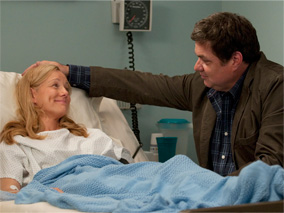
“I don’t want to get sicker trying to get better and then just end up dying anyway” – Cathy, the 42 year old protagonist with advanced melanoma, on the Big C.
—
ML’s incoming search data suggest that some people out there are very determined to know exactly what happens to Cathy in Showtime’s new series about a young-seeming, middle-aged woman with advanced, presumably stage IV, melanoma. In last week’s review I elected not to give it away. Now I’ve reconsidered. So here’s a spoiler alert: Don’t read this post if you don’t want to know what happens to Cathy at the end of the Big C‘s first season.
After months of unusual and comfort zone-breaking behavior, Cathy reconsiders her initial decision to forgo treatment. She, possibly influenced and clearly supported by her husband’s enthusiasm for her middle-aged life and continued existence, indicates that she’s willing and ready to try treatment with Interleukin-2. Cathy seems to know something about the FDA-approved drug, which is generally toxic and ineffective in most melanoma cases. At one point, she lists its putative side effects, according to the show: “burning scabs all over my body, constantly throwing up, fluid on the lungs, my veins could shut down, I could die on the table…”
Nonetheless she decides to accept treatment:
“I’m gonna hang on as long as I can. And I’m going out ugly,” says Cathy, played by the actress, Laura Linney.
“It will never be hard for me to look at you,” responds her supportive husband Paul, portrayed by the actor Oliver Platt.
At this point Cathy’s hoping the Interleukin-2 (“interlaken,” as her husband keeps calling it, perhaps metaphorically, subconsciously, or else just simply) will keep her alive for six months, when she might or might not be eligible for an experimental anti-melanoma drug in a clinical trial.
So she goes for it: in the final scene she’s in the hospital, her mind cloudy, and dreaming. You may wonder what I think of her decision.
As an oncologist I’m half-relieved. The patient will, undoubtedly, die too soon – within months or a year or, if she’s lucky, maybe two years or even longer – because you never really know for sure about these things, if she doesn’t take any treatment. Deaths from metastatic cancer can be unpleasant and painful. On the other hand, conventional therapy for stage IV melanoma rarely leads to complete remissions and, essentially, never cures the disease.
I admired that the patient, until this last episode, maintained such a no-nonsense approach to her condition. Her perspective seemed more mature than her oncologist’s. Despite her weird and nearly unraveling behavior, she’s clearer in her priorities than many patients I’ve known; she seems to understand that a treatment might give her a few additional months but is very unlikely to help her get well and, likely, would make her sick for the duration of her life.
Sometimes oncologists get carried away with hope. What I liked best about the story is that she, the patient, was realistic in this. She didn’t want to take toxic medications in desperation, without reason.
As a patient, my feelings are mixed, too. I respected Cathy lack of passivity in her decision. Accepting treatment initially would have been the easier, “normal” thing in our culture. In effect, so far, Cathy’s taken control of what happens to her body. At the same time, I couldn’t help wonder – what if she tried it? Maybe there is a cure in the pipeline, and she’d be eligible for an experimental agent in a few months, and that drug would help her, and she’d live beyond middle age, or at least until she’s 45 or 46.
Today is Monday, but there’s no new Big C episode because the season’s over. We won’t know how Cathy fares with the Interleukin-2 for a while. Even though she is just a cable TV character, she’s in a position to teach us about oncology and living with cancer.
Hopefully the show’s producers will provide insights into immune treatments, targeted agents, clinical trials, informed consent and palliative care. (I will consider Interleukin 2 and melanoma in a separate post, to follow.) But given the TV scenario, do you think Cathy’s made a sound decision?
—-
Wow, good question and I wish I had a yes/no answer. I guess I should lead with a disclaimer in that I haven’t watched the show (although I’m a huge Laura Linney fan). I guess all I can say about her fictional character is what I say about people in real life–she has to make the decision that feels right to her, and no one else can make that choice. I find it believable that someone who had decided to forego treatment for quality of life reasons could change her mind, for whatever reason–perhaps more than once.
I have no clue what I’d do if I were in her shoes. I like to think I’d vote for quality of life but I honestly don’t know. In my limited experience with early stage breast cancer, I know women in my circumstance who chose radiation/breast conserving surgery where I chose a single mastectomy, and others who chose a preventiave bilateral mastectomy. I learned that we have to do what will let us sleep at night and keep us from second guessing ourselves.
Great discussion topic. Thanks for posting.
As I wrote in an essay about my late daughter’s cancer struggle (hepatoma):
“Post-operative therapeutic literature on HCC is a dense, frustrating tangle of mostly contradiction and disappointment. Chemo protocols declared “significant” in one study are found ineffective in another. The patient cohort sample sizes are too small and/or too unrepresentative to generalize to my daughter’s circumstance. Worse, the “operational definition” of a “success” is usually expressed in terms of weeks’ or months’ life extension beyond that of a control group, with little or no discussion of the quality of life of the therapy recipient. Indeed, beware of the word “palliative,” a term normally connoting “relief of symptoms.” In chemo-speak, however, “palliative” often simply means staving off expected demise for a short time with precious little otherwise “relief” in the bargain.”
Sissy fought like hell for more than two years, and then decided one day “enough of this shit” when the nurse came in with her chemo shot. She pushed her hand away and said “I’m not doin’ this any more.” Three weeks later she died in my arms.