Henrietta’s Cells Speak
“One of the ways that I gained the trust of the family is that I gave them information.”
(R. Skloot, a journalist, speaking about her interactions with Henrietta Lacks’ family, Columbia University, Feb 2, 2010)
This week I had the opportunity to hear a terrific talk by Rebecca Skloot, author of a new, flying-off-the-shelves book –The Immortal Life of Henrietta Lacks.
Mrs. Henrietta Lacks died of metastatic cervical cancer in the colored ward at Johns Hopkins Hospital in Baltimore, MD in September 1951. She lived no more than 31 years and left behind a husband, five children and an infinite supply of self-replicating cancer cells for research scientists to study in years to come.
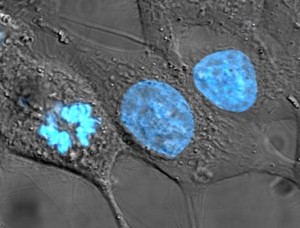
Like many doctors, I first encountered HeLa cells in a research laboratory. Investigators use these famous cells to study how cancer cells grow, divide and respond to treatments. I learned about Mrs. Lacks, patient and mother, just the other day.
Skloot chronicles her short life in fascinating detail. She contrasts the long-lasting fate and productivity of her cells with that of the woman who bore them. She connects those, and her human descendants’ unfortunate financial disposition, to current controversies in bioethics.
In the years following their mother’s death, scientists repeatedly approached her husband and asked her young children for blood samples to check the genetic material, to see if their DNA matched that of cell batches, or clones, growing in research labs.
The issue is this: her husband had but a third-grade education. The children didn’t know what is a “cell,” “HLA-testing” or “clone.”
The family had essentially no idea what the doctors who’d taken, manipulated and cloned their mothers’ cells were talking about, Skloot recounts. They thought the doctors were testing them for cancer.
Years later, when they learned that their mother’s cells were bought, sold and used at research institutions throughout the world, they became angry and distrustful. The problem was essentially one of poor communication, she considered.
“Even a basic education in science would have helped,” Skloot said. “Patients, they want to be asked, and they want to be told what’s going on.”
Well said!
Great post Elaine. The case of Henrietta Lacks exemplifies why good communication is so essential in health care.