|
|
By Elaine Schattner, MD, on January 4th, 2012 Under the radar, over the holiday week, the NEJM published a report on transfusion requirements in older adults who surgical hip repair. The main finding is that most patients, including the elderly and those at risk for cardiac complications of the procedure, don’t benefit from getting so many red blood cell transfusions as is commonly prescribed.
The study, funded by the NHLBI, involved more than 2000 adults over 50 years of age who underwent hip surgery. Overall the patients were quite elderly, with a mean age above 80 in each group. The trial included patients with heart disease and risk factors for cardiac complications. Participants were randomized to receive red blood cells if their hemoglobin fell to a level below one of either two thresholds: 10 or 8 gm/dl. What happened is that, at the time of discharge from the hospital and by 60 days after the procedure, the rates
See more Blood and Hip Surgery: New Study Supports Fewer Transfusions
By Elaine Schattner, MD, on March 27th, 2011
Like many New Yorkers, feminists?, hematologists and other people, I was saddened to learn yesterday of Geraldine Ferraro’s death. The Depression-era born mother, attorney, criminal prosecutor, Congresswoman, 1984 Democratic VP-candidate and part-time neighbor to yours truly, succumbed to complications of multiple myeloma at the age of 75.
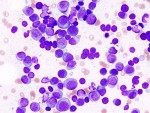
Abnormal plasma cells in a bone marrow sample said to be from a patient with myeloma (Wikimedia Commons). Plasma cells have nearly-round, eccentric nuclei and abundant cytoplasm (ES).
Myeloma is a cancer of plasma cells — specialized white blood cells (mature B lymphocytes) that make antibodies. Plasma cells normally develop in the bone marrow; they can exit into the bloodstream, which is why this condition is often called a tumor of the bone marrow or, occasionally, sometimes, as a leukemia. The term myeloma comes from Greek roots – muelo (which can refer to the bone marrow) and –oma, which in medical parlance
See more Thoughts on Geraldine Ferraro, and Myeloma
By Elaine Schattner, MD, on March 3rd, 2011
Yesterday I learned that Serena Williams, the tennis pro, has been treated for a pulmonary embolus. My husband found out this morning upon reading the newspaper. He wondered why this would happen to a strong, young, athletic woman.
Without delving into the private or specific aspects of her case:
A pulmonary embolism, or PE in doctor-speak, happens when a blood clot enters or forms in the blood supply to the lungs. It’s a serious condition, because when blood vessels in the lungs are compromised, the lung cells can’t deliver fresh oxygen to hemoglobin that would normally pass through in red blood cells. Symptoms sometimes but not always include shortness of breath, pain in the chest that’s sharp in quality, and fatigue. Usually the diagnosis is made by a scan, such as a VQ or a special kind of (spiral) CT.
tennis racket and ball (Wikimedia Commons)
Treatment includes a
See more Tennis News and Why a Healthy Young Woman Might Get a Pulmonary Embolism
By Elaine Schattner M.D., on July 15th, 2010 A few years ago my family took a trip to China. Even before we arrived, I learned something about an unfamiliar health care culture. What I observed en route was that many of the older passengers on that long flight to Beijing were getting up from their seats and stretching. Not just once, but regularly and systematically – they were doing slow motion, isometric calisthenics on the airplane.
I took notice of their behavior first because it seemed a simple and inexpensive, albeit strange example of preventive medicine. Second, as a hematologist who cared for patients with blood clots upon traveling, I pondered the risks and benefits of their on-board exercises. Third, as a patient who’s had a blood clot, or deep venous thrombosis (DVT), I thought maybe I should follow their example.
Thrombophlebitis — the old term for DVT – happens when a vein (as opposed to an artery)
See more Avoiding Blood Clots During Long-Distance Travel
|
|
connections…