|
|
By Elaine Schattner, MD, on May 31st, 2011
 Logo for Frontline, a PBS program
I read in the paper this morning that some hackers successfully (?) broke into the PBS website on Saturday night and posted a story that is untrue. According to multiple sources, the fabricated article stated that Tupac Shakur, a rap performer who died in 1996, is alive and living in New Zealand.
Fox “News” (quotations added by ES) reports a group claiming responsibility was annoyed by a recent Frontline show on WikiLeaks. I googled Tupac and readily identified what is said to be his official website, 2pac.com. There’s a page dated sometime in February 2011, on the Legend:
…Born on June 16 1971 in New York City, Shakur’s parents were both members of the Black Panther Party whose militant style and provocative ideologies for civil rights would come to influence 2Pac’s music. At an early age, Tuapc’s love for performance and the arts began to show, as he began acting
See more Faking the News (and Informational Chaos)
By Elaine Schattner, MD, on May 27th, 2011
 Dear Readers,
Today my younger son will graduate from high school. We’ve got a slew of festivities lined up. I’m happy and excited, and think it wise to sign off for a few days.
Enjoy the weekend!
ES
Related Posts:Happy Thanksgiving!A Change of PaceCelebrating a HolidayAbout this WeekLive Every Week Like It’s Shark Week, Again!
By Elaine Schattner, MD, on May 26th, 2011
 The Times alerted me, this evening:
Lowering bad cholesterol levels reduces heart attack risks, and researchers have long hoped that raising good cholesterol would help, too. Surprising results from a large government study announced on Thursday suggest that this hope may be misplaced.…
Common wisdom has been that such patients should take a statin drug like Lipitor or Zocor to lower bad cholesterol and, in many cases, the vitamin niacin to raise their good cholesterol. But in the trial, niacin provided no benefit over simple statin therapy.
It wasn’t clear to me which was the study, but Bloomberg News explains:
Niaspan failed to prevent heart attacks and may have boosted stroke risk in a U.S.-funded study that calls into question the benefit of raising good cholesterol to combat the leading cause of death.
The National Institutes of Health said today it stopped a 3,414-person study early after the addition of Niaspan to simvastatin, a standard
See more News on Niaspan, Cholesterol Drugs and Biomarkers
By Elaine Schattner, MD, on May 26th, 2011
 A short note on Good People, the title of a new play at the Manhattan Theatre Club starring Frances McDormand –
It’s a simple story, at some level, about a middle-aged woman from south Boston who loses her job. She has a disabled, adult daughter who needs caregiving, and she needs money. She contacts some old friends, and scours the neighborhood for a job. She encounters a once-boyfriend, just for a summer at the end of her childhood, who’s become a doctor with a fancy office and a fancy house and a beautiful wife.
Frances McDorman, in a photo for the MTC
And she’s angry, angry because she’s never been able to leave her community despite, as she puts it, “being nice.” She put her daughter’s needs first and helped others when she could – or so she says, but she was too often late for work at one job and the next, because she was waiting for the daughter’s sitter, or
See more Good People, a New Play About Chance, Decisions and Fate
By Elaine Schattner, MD, on May 24th, 2011
 This morning’s med-blog Grand Rounds is up at MedGadget, where my colleague Dr. Nick Genes has put together a nice assortment of reads. One entry refers to the Plutchik Emotion Circumplex – “a wonderful graphic representation of a highly regarded emotion classification system.”
Plutchik’s diagram, as featured in his book: “Emotions and Life: Perspectives From Psychology, Biology, and Evolution”
I never took psychology in college, and in med school they sent us straight onto (into?) the psychiatry wards. For whatever reason, I wasn’t familiar with the colorful schematic. Here’s what I learned today:
Dr. Robert Plutchik was an academic psychologist and author best known for his work on the nature and evolutionary aspects of emotions. He was a Brooklynite who attended City College, received a Ph.D. from Columbia University and became a professor at the Albert Einstein College of Medicine. According to an obituary in now-defunct New York Sun, after retiring he moved
See more Psychology Colors and Emotions, from the Late Dr. Robert Plutchik
By Elaine Schattner, MD, on May 23rd, 2011
 A few more thoughts on the CDC’s zombie ploy –
Today’s Disruptive Women in Healthcare features a post applauding the agency’s out-of-the-box “thinking” to get the public’s attention turned to emergency preparedness. (As if that should be necessary, just after the worst radiation disaster in decades, as tornadoes rip through hospitals here in the U.S.)
The approach seems like it might be confusing to people who are uneducated and perhaps can’t distinguish between the probability of a zombie invasion, UFOs and, say, re-emergence of the plague or the complete loss of electricity in North America. It seems careless, even unprofessional. I prefer the CDC be serious, 365/7/24.
The approach is patronizing, besides. I’m a woman who assumes responsibility for her health. Telling stories to gain people’s attention is how we treat children and early adolescents. It’s not for me.
As a blogger and journalist who looks at medical media, I can see that the topic garnered lots
See more Zombies are For Children, and Hits
By Elaine Schattner, MD, on May 22nd, 2011
Last week Aaron Sorkin wrote for The Atlantic a piece in which he details his daily news feed, in What I Read. He’s not into blogs:
When I read the Times or The Wall Street Journal, I know those reporters had to have cleared a very high bar to get the jobs they have. When I read a blog piece from “BobsThoughts.com,” Bob could be the most qualified guy in the world but I have no way of knowing that because all he had to do to get his job was set up a website–something my 10-year-old daughter has been doing for 3 years. When The Times or The Journal get it wrong they have a lot of people to answer to. When Bob gets it wrong there are no immediate consequences for Bob except his wrong information is in the water supply now so there are consequences for us.
PZ Meyers, whose tagline for Pharyngula at ScienceBlogs is a bit crass for my taste,
See more On Media Snobs and Darwinism in the Blogosphere
By Elaine Schattner, MD, on May 20th, 2011
 A note on cooking with leeks, inspired by a NYT Well post with a list of related Recipes for Health:
I use leeks all the time, as my neighbors are probably too aware. I use leeks sautéed in olive oil as filler, mixed with an egg and flour for a tart, or to season simple pasta, or to flavor and decorate roasted potatoes.
How I prepare leeks is this:
First I cut off the base and ragged tips of 3–4 stems, slice the mainly dark-green stems lengthwise, and then cut the stalks into 1 — 3 inch sections, depending on what they’ll be used for. Because there’s often dirt from the ground deep in the lower, paler sections of the leeks, I manually expose and separate each rounded layer, and then wash everything under briskly-running water, thoroughly rinsing at least three times.
You don’t have to dry the cut, washed leeks. What I do is heat a heavy, wide pan on
See more Cooking With Leeks
By Elaine Schattner, MD, on May 19th, 2011
 I’m coming down hard on the CDC’s fake zombie alert/true public awareness campaign. Here’s how it seemed to this reader:
First, a late-afternoon feed from Wednesday’s WSJ Health blog alerted me to what might be strange happenings: CDC Advises on Zombie Apocalypse … and Other Emergencies. If this title had come from another, less serious source, I would have ignored what I thought was a joke. But, coming from where it did, I clicked. Here’s what the WSJ blog had to say:
Uncle Sam wants YOU to be prepared for a zombie apocalypse.
The Centers for Disease Control and Prevention, known best for stamping out health threats like Ebola and E. coli, is now advising people how to prepare for a zombie invasion…
Okay, the agency really is just looking for a clever way to get people to heed its advice on how to prepare for emergencies such as hurricanes — which on its own, let’s face it,
See more On Fake Zombies, and Mistakes at the CDC’s Public Health Matters Blog
By Elaine Schattner, MD, on May 19th, 2011
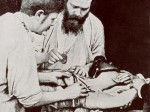
 CBS News has posted a gripping set of images, mostly of cancer patients, dating to the 1880s. The photos from the Burns Archive are graphic, as much as they’re telling, instructive and rare.
This photograph, taken in New York City in 1886, is one of the earliest ever taken of breast surgery. Surgeons had begun to adopt infection-control measures in the operating room, but at this point they hadn’t yet adopted the use of surgical masks and hats and their surgical gowns were simply put on over their street clothes. The anesthesiologist whose hands are visible holding the patient’s arm on the left side of the frame is wearing street clothes. Anesthesiologists were the last doctors to don surgical clothing in the operating room.
Credit: Dr. Stanley B. Burns, via CBS News
According to its website, the Burns Archive houses the nation’s largest and most comprehensive collection of
See more First Look at the Burns Collection of Early Medical Photographs
|
|